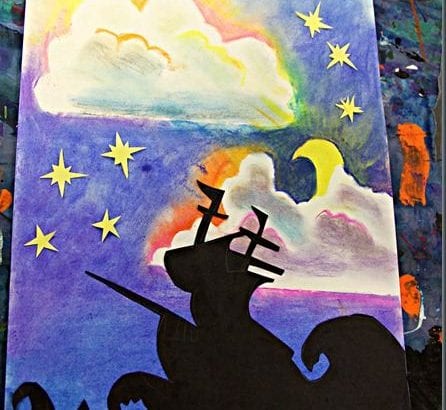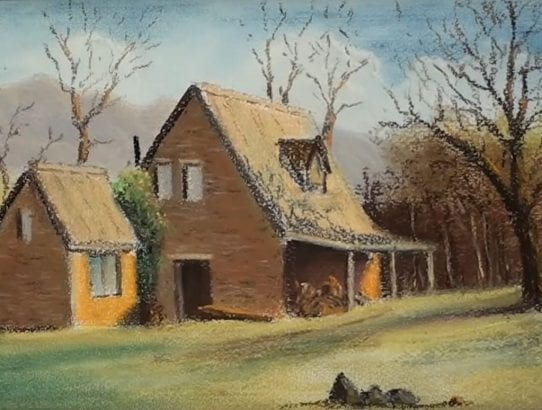
For our last artwork in Term One, we created these ghost gum artworks using chalk pastels. Miss B (who loves using these for her artworks) showed us the different ways to smudge and blend the chalk pastels.
We have been working so hard on these sculptures! As part of our Science unit of work on Packaging, we had to design and make a package for these kinetic sculptures to sell at Market Day. Here is the video we watched to learn how to make them:
And here are some photographs of the finished products ready for Market Day! The packaging looks great everyone, and meets the design brief!
But behold, see them in action!
Sold out on Market Day! Great job 5/6J! Thanks to Blick Art Supplies for the idea!
If you have finished your other artworks, you may like to try your luck at Three Point Perspective.
First of all, watch and copy this tutorial:
Then grab some grid paper from Miss B and clip it in place behind some blank paper. Use the grid to try and draw a ‘worm’s eye perspective’ artwork of city buildings, a church, a house or a castle.
Slowly but surely our Renaissance Portraits are being finished. Oncewe had painted our faces and backgrounds, we framed them in gold, silver or purple paper and laminated them.
Then three portraits are being hung from the ceiling. They look amazing! We have some super talented people in our class.
Learning Intention: To create a landscape that uses one point perspective as a way to show depth in an artwork.
Artists use perspective to show depth in their artworks.
There is three types of perspective, one point, two point and three point perspective.
One point perspective was first seen in many artworks from the Renaissance. It is also known as Linear Perspective.
Before the Renaissance artists tried to make their artwork have depth and look Three Dimensional, but there were no concrete rules about how to do this. The artist below tried to make his work look 3D. Does it look realistic enough?
To create one point perspective you need a horizon line, a vanishing point and orthogonal lines. Can you identify these in the image below?
We are going to create an artwork using linear perspective. But first, let’s do some practicing!
Let’s create the simple artwork in this video.
You can have a lot of fun with One Point Perspective.
So let’s now look at the sort of artwork we will be creating using one point perspective.
Are we ready to create a one point perspective artwork? Let’s work out the steps together.